

Fraunces Tavern
Also known as Fraunces's Tavern, DeLancey House, and Queen's Head Tavern
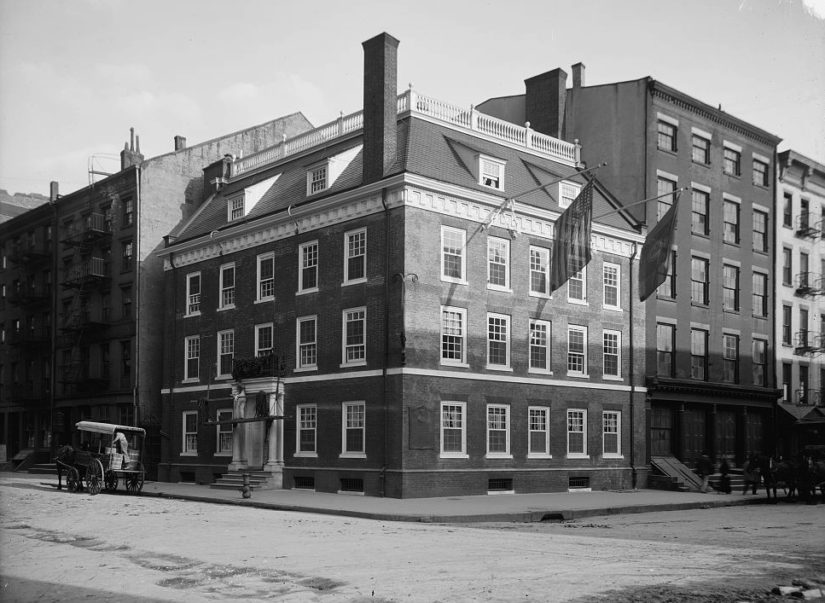
Fraunces Tavern, one of the first buildings to be designated as a New York City Landmark in 1965, was originally built in 1719 but was controversially reconstructed in 1906 in an attempt to restore a colonial appearance.
The building known today as Fraunces Tavern located on the corner of Broad and Pearl Streets, has had many roles throughout the City’s history. Often celebrated as one of downtown’s last vestiges of colonial architecture, today’s tavern bears little resemblance to the original structure. As it stands today, the building is a reconstruction based almost entirely on 20th century conjecture, a fact that has made it a controversial subject among preservationists.1
The tavern was originally built as a private city residence by Etienne DeLancey in 1719 on land conveyed to him by his father-in-law, Stephanus Van Cortlandt, the great Dutch magistrate. DeLancey built his house in opulent style to reflect his wealth and success as one of the City’s leading merchants. The house stood three stories high with walls made of bricks imported from Holland. The interior of the house boasted fourteen fireplaces, a large kitchen and a dry cellar—all luxurious features for the time.2 The house ceased to be exclusively a private dwelling in 1757, when the two lower floors were used as a warehouse by DeLancey, Robinson & Company.3 In 1761, the building was sold to Samuel Fraunces, a noted innkeeper, who opened it as the “Queen’s Head Tavern” in reference to his sign depicting an effigy of Queen Charlotte, wife of King George II.4
As a tavern and public house, the building was a veritable center of colonial life. The “good cookery and excellent wines” made it a favorable meeting place for various societies, activists, and public events. It housed the very first meeting of the New York Chamber of Commerce in 1768 and was a regular meetinghouse for the Sons of Liberty as well as for merchants converging about the Stamp Act.5,6 Most notably, the tavern served as George Washington’s final residence during the week following the evacuation of the British troops in 1783. It was here that he ceremoniously bade farewell to his officers, marking the final stage of the Revolutionary War.7 In 1785, the building was apportioned into offices for the Continental Congress. During New York City’s brief interlude as U.S. capital, the building was headquarters for the departments of Foreign Affairs (1785), Treasury (1787), and War (1787).8 In 1788, when the government moved to Philadelphia, and later to Washington, D.C., the building became a boarding house, a saloon, and, later, Glinktenkamp & Precht, a German beer bar with parlor and boarding rooms.9
The building suffered a number of fires throughout the 19th century, after which damaged portions were rebuilt and frequently added onto. At each change of occupancy, remodeling took place to suit the current needs. Nearly all windows, doors, walls and entrances were altered or removed. Many architectural elements, even some of the structural timber, were auctioned off as souvenirs.10 In 1852, following another devastating fire, two additional stories and a flat roof were added and most of the brick was replaced by cement. By 1904, when the building was purchased by the Sons of the Revolution, what little remained of the original 18th century structure had been overlaid and obscured.11
In 1906, the Sons of the Revolution hired architect William Mersereau to “restore” the building to its colonial appearance. They planned to revive it as a tavern and make it the society’s headquarters. Efforts were made to research the original structure and salvage any original material, however, little information was found. Not even a picture was available. The “restoration,” therefore, was a highly speculative one, almost an entirely new construction based on a conglomeration of examples from the period and clearly influenced by the Colonial Revival Movement so popular at the time.12 Throughout the 1940s, ’50s and ’60s, the Sons of the Revolution purchased four abutting buildings: 58 Pearl Street, 101 Broad Street, and 24 and 26 Water Street, which became a part of the museum complex.
Fraunces Tavern was one of the first buildings to be designated as a New York City Landmark in 1965. Fraunces Tavern Block was designated a New York City Historic District in 1978. Since 1904, Fraunces Tavern has been owned and operated by the Sons of the Revolution as a tavern and colonial museum.
1890: The Holland Society commemorates Fraunces Tavern's history with a plaque
1904: Since this year Fraunces Tavern has been owned and operated by the Sons of the Revolution as a tavern and colonial museum
1906: The Sons of the Revolution hires architect William Mersereau to "restore" the building to its colonial appearance
May 1, 1907: The Sons of the Revolution reopen the building as a tavern and colonial museum, with their headquarters atop
1965: Fraunces Tavern is one of the first building in New York City to be designated a New York City Landmark
1978: The Fraunces Tavern Block is designated a New York City Historic District
Interest in preserving this 18th-century building began as early as 1890 when the Holland Society commemorated the building's history with a plaque. It read: "The old Fraunces Tavern was situated here. Erected by Etienne De Lancey, Samuel Fraunces purchased and opened it as a public house in 1762 under the sign of Queen Charlotte."13 Beginning in 1899, the Women's Auxiliary of the American Scenic and Historic Preservation Society made several attempts to secure the tavern. They proposed the City buy the building through condemnation procedures, restore it to its original condition, rent it to a tavern keeper and turn the surrounding block into a public park.14 However, adjoining property owners objected to the park feature, not wanting to relocate their businesses.15 Others opposed the cost of the proposal at the public's expense, as Coenties Slip Park, located half a block to the east, already served the outdoor recreational needs of the community.16 Still others took issue with the Society's plan to relocate the tavern to the center of the block, which they felt would destroy the value of the building as an historic relic.17 A second proposal called for the City to purchase the tavern and only a narrow strip of land around the building.18
In February 1904, the Board of Estimate decided against acquiring the surrounding block and plans for the preservation of the tavern were halted.19 Despite this, in May 1904, the Society of the Sons of the Revolution purchased the tavern. They then hired architect William H. Mersereau in 1906 to restore the building "as nearly as possible" to its former colonial appearance20 and make it the society's headquarters.
However, little source material was uncovered indicating the original appearance of the building, apart from the original description of the building as an "elegant three-story and half brick dwelling."21 Mersereau, therefore, relied heavily on other architectural examples of the period to inform his design. One such example was the Frederick Phillipse Manor House in Yonkers, whose hip roof Mersereau used as a model.22 A 1906 photograph taken during the "restoration" shows the tavern as a naked frame after the two upper stories had been removed, the interiors gutted and the exterior walls on three sides had been demolished.23 Although efforts were made to salvage original material, the tavern contained almost no remnants of woodwork that had existed in George Washington's time.24 The only authentic discovery was the oak hewn beams found in the floors and ceilings of a few of the rooms on the second and third stories, including the famous Long Room, on either side of which were vestiges of hand-split laths and handmade nails.25
What was promised to be a "restoration" of the deteriorated tavern became almost entirely a "reconstruction."26 Criticism of the project was sharp and immediate. A letter to the editor of The New York Times from 1906, describes the work done on the tavern as a "scoundrelly piece of vandalism," the writer accuses Mersereau of "deplorable destruction" and asks: "How can men or women, who are pledged to preserve evidences of our country's history, give their consent to so much destructive work?"27 Despite mounting criticism, the Sons of the Revolution reopened the building as a tavern and colonial museum, with their headquarters atop, on May 1, 1907.
The ardent criticism that began during the 1906 reconstruction continued to be impassioned for the greater part of the century. As the reconstruction became more and more a thing of the past, more and more of the public began to erroneously regard and accept Fraunces Tavern as an authentic colonial structure. This fact, along with a new trend for reconstructing 18th-century buildings while 19th-century buildings were being demolished at an increasingly alarming rate, sparked a fury among architectural historians and preservationists, who railed against these false interpretations through articles, letters to the editor, and other publicized methods.
Ada Louise Huxtable, former architecture critic for The New York Times, was among those at the forefront of this dispute, using her column as an arena for preservation debate. In her 1965 article, "Lively Original vs. Dead Copy," she describes Fraunces Tavern as neither "old, nor authentic, nor preservation."28 She begs for the tavern to be presented as what it really is: "a modern copy created by scholarly guesswork on some old bones" that possesses "some associative historical usefulness," and she condemns the assertion of the building as "original" to be "a serious error."29 In other examples, she berates the act of reconstruction as a "perversion," a "fakery," a "make-believe" and reminds her readers that the whole point of preservation is not to recreate the past, "a laughable impossibility filled with booby traps," but to retain the buildings of the past so that they can remain a "part of the living heritage of the present."30 Despite this criticism, Fraunces Tavern was one of the first buildings to be designated as a New York City Landmark in 1965.
In the 1970s, the block surrounding Fraunces Tavern was threatened with demolition. In 1974, the Uris Corporation, owner of the buildings, moved forward with plans to replace several of the buildings with a parking lot.31 Faced with the loss of these buildings, the New York Landmarks Conservancy stepped in to halt the demolition. The Conservancy worked with the Sons of the Revolution "to organize a feasibility study of preservation possibilities" and to find an alternative to demolition.32 In 1978, the buildings on the Fraunces Tavern Block were saved when the New York Landmarks Conservancy purchased them.33 The transaction was possible due to a grant the Conservancy received from the Astor Foundation and a generous deal from Warner Communications. After the block was saved and the deeds transferred, the New York City Landmarks Preservation Commission designated it as an historic district in 1978.
- Anthony C. Wood Archives
New York Preservation Archive Project
174 East 80th Street
New York, New York 10075 - Tel: (212) 988-8379
Email: info@nypap.org
- Oral Histories with Simon Breines and Susan Henshaw Jones
New York Preservation Archive Project
174 East 80th Street
New York, NY 10075
Tel:(212) 988-8379
Email: info@nypap.org
- Norvell White and Elliot Willensky, AIA Guide to New York City: The Classic Guide to New York’s Architecture (New York: Crown Publishing Group, 2000).
- William H. Mersereau, “How Fraunce’s Tavern was Restored,” The New York Times, 17 March 1907.
- ”Old Fraunce’s Tavern,” New York Tribune, 29 July 1890.
- Benson J. Lossing, “Historic Houses of America,” Appleton’s Journal of Literature, Science and Art Vol. 11, No. 272 (4 June 1874).
- ”Fraunce’s Tavern Restored, Dedicated,” The New York Times, 5 December 1907.
- William H. Mersereau, “How Fraunce’s Tavern was Restored,” The New York Times, 17 March 1907.
- William S. Baker, “Itinerary of General Washington From June 15, 1775 to December 23, 1783,” Pennsylvania Magazine of History and Biography Vol. 15 (1891).
- ”Fire Damages Room at Fraunce’s Tavern,” The New York Times, 1 July 2001.
- ”May Hide Dark Secrets of Fraunce’s Tavern,” The New York Times, 20 May 1904.
- ”Old Fraunce’s Tavern,” New York Tribune, 20 July 1890.
- Ada Louise Huxtable, “Fraunce’s Tavern Controversy,” The New York Times, 6 June 1965.
- New York City Landmarks Preservation Committee, Guide to New York City Landmarks, 4th ed. (Hoboken: John Wiley & Sons, Inc., 2009).
- ”Holland Society Tablets,” The New York Times, 30 September 1890.
- ”Fraunce’s Tavern,” The New York Times, 30 May 1902.
- ”Fraunce’s Tavern Protest,” The New York Times, 23 January 1903.
- ”Fraunce’s Tavern,” The New York Times, 30 May 1902.
- ”Fraunce’s Tavern: Arguments For and Against Purchase of Sufficient Land Around It For a Park,” The New York Times, 7 February 1904.
- Ibid.
- ”No Fraunce’s Tavern Park,” The New York Times, 27 February 1904.
- ”Sons of the Revolution Buy Fraunce’s Tavern,” The New York Times, 19 May 1904.
- Ada Louise Huxtable, “Fraunce’s Tavern Controversy,” The New York Times, 6 June 1965.
- William H. Mersereau, “How Fraunce’s Tavern was Restored,” The New York Times, 17 March 1907.
- Ada Louise Huxtable, “Fraunce’s Tavern Controversy,” The New York Times, 6 June 1965.
- William H. Mersereau, “How Fraunce’s Tavern was Restored,” The New York Times, 17 March 1907.
- Ibid.
- Ada Louise Huxtable, “Fraunce’s Tavern Controversy,” The New York Times, 6 June 1965.
- T. S. Affleck, “Letter to the Editor: Renovation That Leaves No Vestige of the Original Building,” The New York Times, 15 September 1906.
- Ada Louise Huxtable, “Lively Original vs. Dead Copy,” The New York Times, 8 May 1965.
- Ada Louise Huxtable, “Fraunce’s Tavern Controversy,” The New York Times, 6 June 1965.
- Ada Louise Huxtable, “Where Did We Go Wrong?” The New York Times, 14 July 1968.
- Fraunces Tavern Block Historic District Designation Report, 14 November 1978.
- Ada Louise Huxtable, “Architecture: The Bulldozer Approaches a Historic Block,” The New York Times, 14 July, 1974.
- Donald G. McNeil, “Five Historic Manhattan Buildings Sold to Restorers,” The New York Times, 6 May 1978.